
AI Agents Examples for Consulting Firms
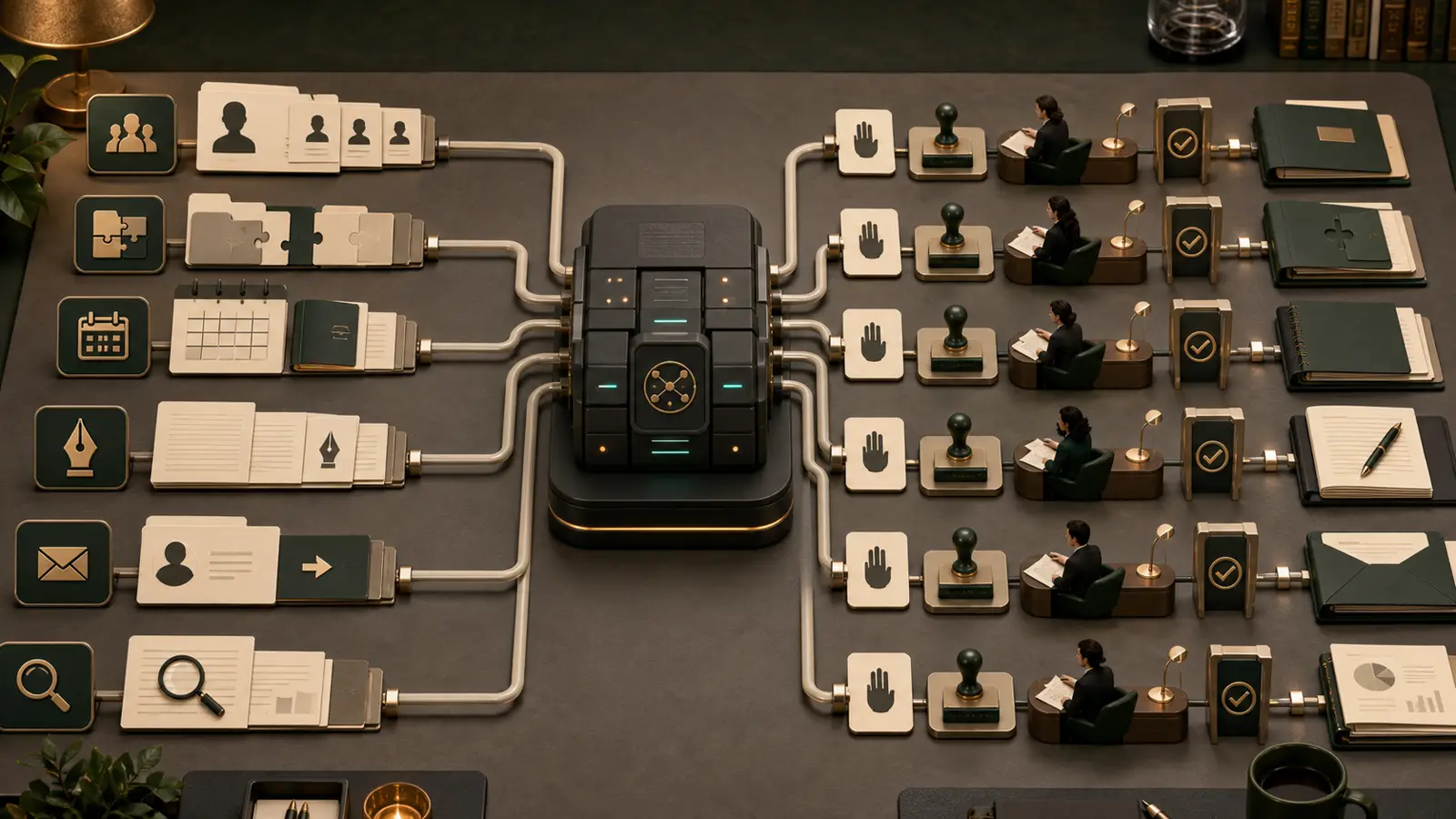
Six AI agent workflow designs for consulting firms, each with a trigger, agent work, human decision, output artifact, and automation boundary.
AI Agents Examples for Consulting Firms
The useful AI agents examples for a consulting firm are bounded workflows, not digital partners with open-ended authority. Each design starts with a known input, gives the agent a defined job, and ends with an artifact a person can inspect. The human keeps the decision that carries client, candidate, deal, or relationship judgment. Nothing external happens without approval. This article maps six workflow designs for executive search, M&A advisory, private banking, and boutique consulting. They are design patterns, not AI Jungle client deployments or reported results.
For the buyer's specification and delivery-model questions behind these patterns, see the custom AI agents for consulting firms buyer's guide.
For a project-management workflow with explicit permissions, evidence, and stop conditions, see the AI agents for project management: a safe workflow.
What is an AI agent in a consulting firm?
An AI agent is software that works toward a goal and can choose or execute steps within defined boundaries. Workday describes agentic systems as systems that sense inputs, process signals, make decisions, and act toward specific outcomes with limited human direction (Workday). IBM distinguishes agentic systems from single-task assistants and chatbots because agents can plan, reason, execute tasks, and call external tools (IBM).
That definition matters inside a consulting firm. A prompt that turns notes into a summary produces text. An agent workflow can receive approved material, inspect it against a brief, create a draft artifact, route uncertainty to a person, and wait for a decision.
The workflow should be written like a job card:
- Trigger or input: What starts the work, and which material may enter?
- Agent work: Which steps may the system perform?
- Human decision: Who accepts, edits, rejects, or redirects the work?
- Output artifact: What can the reviewer inspect and retain?
- Do-not-automate boundary: Which action stays outside the agent's authority?
This structure turns an abstract AI idea into a workflow a partner can challenge. It also gives the team a place to record corrections. Databricks says production-ready agents need evaluation, monitoring, governance, human-in-the-loop design, and deliberate control of autonomy (Databricks). The job card makes those controls visible before anyone connects a tool.
For the operating model around these workflows, see the managed AI agent service and the guide to AI agents for boutique consulting firms.
Which agent examples are useful?
The patterns below are proposed workflow designs. They show where the agent stops as carefully as they show what it does.
| Consulting workflow | Trigger or input | Agent work | Human decision | Output artifact | Do-not-automate boundary |
|---|---|---|---|---|---|
| Executive-search candidate brief | Approved role brief, candidate material, and firm notes | Organize evidence against the approved brief and mark missing support | Search consultant decides the assessment and next step | Candidate evidence brief with source pointers and open questions | No candidate ranking, rejection, outreach, or representation of fit |
| Executive-search mandate preparation | Approved mandate notes and meeting material | Extract stated requirements, conflicts, unknowns, and questions | Partner confirms the mandate interpretation | Mandate preparation memo | No change to mandate terms and no client communication |
| M&A opportunity intake | Submitted teaser or approved deal material plus an intake rubric | Extract stated facts, map them to rubric fields, and flag missing items | Adviser decides whether the opportunity enters review | Structured intake memo with evidence links | No valuation, recommendation, bid, or contact with a counterparty |
| Private-banking meeting preparation | Approved relationship notes and meeting agenda | Assemble a dated briefing from permitted records and label gaps | Relationship manager selects what is relevant for the conversation | Meeting brief and question list | No suitability judgment, product recommendation, transaction, or client message |
| Boutique-consulting proposal preparation | Approved discovery notes and scope template | Map stated needs to draft sections and flag unsupported assumptions | Engagement lead owns scope, commitments, and final wording | Proposal draft with an assumption log | No price, promise, contract term, or send action |
| Business-development follow-up | Approved meeting notes and contact record | Draft a follow-up tied to the recorded conversation and queue it for review | Relationship owner edits or rejects the message | Draft plus approval record | No autonomous send, invented personalization, or unapproved claim |
Executive-search candidate evidence brief
Trigger or input: An approved role brief, candidate-provided material, and notes the firm permits the workflow to use.
Agent work: Build an evidence map. Put each role requirement beside supporting material. Mark any item that lacks support. Draft questions for the consultant.
Human decision: The search consultant decides what the evidence means. The consultant owns any assessment, shortlist decision, and candidate conversation.
Output artifact: A candidate evidence brief with source pointers, missing evidence, and questions.
Do-not-automate boundary: The agent does not rank or reject candidates. It does not contact them. It does not state that a candidate fits a role.
This is an evidence-assembly pattern. It keeps relationship judgment with the search professional. A separate business development AI agent pattern can support approved follow-up work, but it should not inherit authority over candidate decisions.
Executive-search mandate preparation
Trigger or input: Approved notes from a mandate discussion, the stated role material, and the firm's preparation template.
Agent work: Extract the requirements that appear in the material. Separate confirmed points from unknowns. Surface conflicts between the notes and the supplied role material.
Human decision: The partner confirms the interpretation and chooses the questions for the client.
Output artifact: A preparation memo with confirmed requirements, open questions, and source references.
Do-not-automate boundary: The agent cannot rewrite mandate terms, promise a search outcome, or communicate with the client.
The design gives the partner a reviewable object before the next conversation. It does not turn interpretation into an automated decision.
M&A opportunity intake
Trigger or input: A submitted teaser or other approved deal material, plus the firm's intake rubric.
Agent work: Extract statements from the source material into the rubric. Keep the source attached to each entry. Leave a field blank when the material does not support an answer. List questions that require an adviser.
Human decision: The adviser decides whether the opportunity enters review and what diligence follows.
Output artifact: A structured intake memo with evidence links, blank fields, and an open-question list.
Do-not-automate boundary: The agent does not value the business, recommend a transaction, place a bid, or contact any party.
This pattern is intentionally narrow. It turns submitted material into an inspectable intake artifact. It does not decide whether the deal is attractive.
Use the Leverage Assessment to map one of these patterns against the records, approvals, and boundaries inside your firm.
Private-banking meeting preparation
Trigger or input: Records approved for the workflow and a meeting agenda.
Agent work: Assemble a dated brief from those records. Separate recorded facts from unanswered questions. Point the relationship manager back to the source for each material item.
Human decision: The relationship manager decides what belongs in the meeting and how to discuss it.
Output artifact: A meeting brief, a source list, and questions for human review.
Do-not-automate boundary: The agent does not make a suitability judgment, recommend a product, initiate a transaction, or send a client message.
IBM describes agents as systems that can plan and act through external tools (IBM). That action capacity is why the boundary belongs in the workflow design, not in an unwritten assumption.
Boutique-consulting proposal preparation
Trigger or input: Approved discovery notes and the firm's scope template.
Agent work: Place stated needs into draft sections. Mark every assumption that the notes do not support. Create a question list for the engagement lead.
Human decision: The engagement lead owns the interpretation, scope, commitments, and final language.
Output artifact: A proposal draft paired with an assumption log.
Do-not-automate boundary: The agent does not set a price, add a promise, alter contract language, or send the proposal.
The assumption log is part of the output, not a side note. A polished draft without visible uncertainty invites a reviewer to approve wording that the source material did not establish.
Business-development follow-up draft
Trigger or input: Approved meeting notes and an approved contact record.
Agent work: Draft a follow-up tied only to the recorded conversation. Mark any sentence that needs confirmation. Place the draft in a review queue.
Human decision: The relationship owner edits, approves, or rejects the draft.
Output artifact: The draft, its cited note fragments, and an approval record.
Do-not-automate boundary: No autonomous send. No invented familiarity. No claim that is absent from the approved record.
This pattern embodies the rule that nothing ships without your yes. The approval record keeps the decision attached to the artifact.
Where must a human approve?
A human should approve at the point where assembled evidence becomes professional judgment or an external action. The exact gate depends on the workflow, but the owner must be named before the agent runs.
Keep these decisions with a person:
- Whether a candidate fits a mandate
- Whether a deal enters review
- What to recommend in a client conversation
- Which scope, commitment, or price belongs in a proposal
- Whether a message may leave the firm
- Whether an unsupported or conflicting item can be resolved
The agent may prepare the decision packet. It may not silently become the decision-maker. Evidently AI describes a deployed system that flags outputs below set confidence thresholds for human review, and it also describes human evaluation for edge cases in another agent system (Evidently AI). These examples show two ways to route uncertainty. A consulting workflow still needs a named reviewer who owns the final call.
Approval also needs an artifact. A chat message that says "looks fine" gives little context later. The review object should show the input, draft, flagged gaps, reviewer decision, and approved version. For a dedicated walkthrough, read the AI Jungle guide to approval gates for AI agents.
Is ChatGPT an AI agent?
ChatGPT can be part of an agent workflow, but a chat response alone does not meet the operating definition used in this article. IBM distinguishes single-task assistants and chatbots from agentic systems that plan, reason, execute tasks, and call tools (IBM). Workday likewise defines an agent through goal-directed action within boundaries (Workday).
Use a simple test. Does the system have a defined goal? Can it select steps? Can it use approved tools or records? Can it produce or route an action? Does it stop at a named approval gate? If the answer is only "it replies to a prompt," treat it as an assistant. If the surrounding system adds goals, tools, state, actions, and controls, ChatGPT may serve as one component in that agent design.
The job card governs the workflow. Buying an "agent" does not create a safe workflow. Writing the authority, inputs, artifact, reviewer, and boundary does.
How should a first workflow be chosen?
Choose the first workflow by inspectability. The team should be able to see what entered, what the agent did, what it produced, and where a person decided. Workday identifies clear goals, repeatable logic, and access to clean, structured data as workflow-selection criteria (Workday).
Use this readiness checklist:
- [ ] The trigger can be written in one sentence.
- [ ] The permitted inputs are named.
- [ ] The agent's steps fit on a short job card.
- [ ] The output is an artifact a reviewer can inspect.
- [ ] One person owns approval.
- [ ] The do-not-automate boundary is explicit.
- [ ] Missing evidence produces a flag or blank field, not a guess.
- [ ] External actions remain behind approval.
- [ ] Corrections can be recorded against the artifact.
- [ ] The firm can stop the workflow without losing the source record.
Reject a candidate workflow if the team cannot agree on the output or reviewer. The same applies when success depends on an undefined judgment that nobody can explain. Start with a workflow whose input and artifact are visible.
Use the first AI agent finder to turn a backlog into a candidate workflow. Use the AI assessment when the issue spans data, ownership, and operating readiness.
FAQ about AI agents examples
What is an example of an AI agent?
One example is a proposed consulting-firm workflow for proposal preparation, not a deployed client result. It takes approved discovery notes, maps stated needs into a scope template, flags unsupported assumptions, and stops for engagement-lead approval. The retained artifact is a proposal draft plus an assumption log. Price, promises, contract terms, and sending remain outside the agent's authority.
Can an AI agent contact a candidate or client?
It can only do so if the workflow grants that authority. The patterns in this article do not. They place candidate and client messages behind a named human approval gate. The draft and approval record remain visible before any send action.
Should one agent handle research, judgment, and sending?
Not in these designs. Each pattern separates evidence assembly from professional judgment and external action. The agent prepares an artifact. A named person decides. The send or transaction boundary stays closed unless the firm creates a separate, explicit approval rule.
What should happen when the source material is incomplete?
The agent should leave the field blank, flag the gap, or draft a question. It should not invent the missing fact. The reviewer then decides whether to seek evidence, revise the task, or stop the workflow.
What is the next step after choosing a pattern?
Write the job card with the five fields used in this article. Test whether the team can identify the source record, output artifact, human owner, and forbidden action. Then use the Leverage Assessment to map the workflow before connecting it to live firm systems.
Written by Tileo, the operator who runs AI Jungle's own agent workforce.
Written by
AI Jungle
AI Jungle Editorial turns real operating experience into practical field notes for firms deciding what work an agent should own.
Related field notes
AI Agent Pilot for Boutique Consulting Firms
Turn a demo into a workflow your team can use. Choose one partner bottleneck, test real inputs and measure the effort left for human review.
AI Agent StrategyAI Agents for M&A Advisory Firms
Less time assembling the same deal context. Explore AI workflows for research packs, meeting briefs and mandate updates, with adviser review.
AI Agent StrategyHow Do I Choose Worker Agents for Consulting Firms
Choose bounded worker roles by defining artifacts, source boundaries, acceptance tests, stop conditions, and accountable owners.