
Best AI Agents for Small Business 2026
Compare four AI agent options for small service businesses by job, operating owner, approval point, and maintenance responsibility.
The best AI agents for small business in 2026 depend on the job and the person available to operate the system. For a small service business, our editorial shortlist is AI Jungle, n8n, Lindy, and Claude Team. AI Jungle publishes this guide and appears first by explicit editorial choice. This is not an independent benchmark, a claim of universal performance, or a guide to retail operations.
Find the right AI workflow starting point
Three questions to explore a first step. This is an initial direction, not an expert assessment. Answers stay on this page.
Choose one answer in each group to explore a possible next step.
An educational exercise, not a scored assessment. No assessment request is submitted when you use this chooser.
The audience here is a service business whose owner and team handle inquiries, meetings, proposals, follow-up, and client delivery. The four options are different forms of purchase. AI Jungle offers an operated service. n8n is a configurable workflow platform. Lindy is connected software the team configures and uses. Claude Team is a shared team tool for consultant-led drafting and research.
Our verdict: begin with one recurring service-business job and name its operator. The product decision comes after the trigger, permitted sources, reviewable output, approval owner, and stop conditions are clear.
Which small-business job should an AI agent handle?
Choose a job that already has a recognizable start and finish. “Help with admin” is too broad. “Prepare a meeting brief from the approved client record and permissioned notes” gives the buyer something to test.
| Job | Trigger | Reviewable output | Human decision | Buying form to inspect |
|---|---|---|---|---|
| Owner admin | A named recurring task becomes due | A draft checklist or internal brief | Owner accepts priorities and exceptions | Consultant-led tool or configured workflow |
| Inquiry intake | A permitted inquiry enters the agreed channel | A structured intake summary with unknowns marked | Owner decides qualification and response | Configured workflow or operated service |
| Meeting preparation | A scheduled meeting has approved source material | A sourced preparation brief | Meeting owner checks facts and decides the approach | Shared team tool, configured workflow, or operated service |
| Follow-up | A person approves the meeting record | A follow-up draft tied to approved notes | Responsible person approves before sending | Any option with an explicit approval point |
This table describes jobs, not product guarantees. A candidate should show how its proposed setup handles the exact input, artifact, and approval step. The client acquisition workflow, meeting preparation workflow, and client follow-up workflow can help make those boundaries concrete.
What are the best AI agents for a small service business?
Every option below receives the same decision fields. The order reflects a buyer that values continuing provider responsibility. A business with a capable internal operator may reach a different conclusion.
1. AI Jungle
- Offering: A managed route that starts with one bounded workflow and continues through Assessment, Iterative Build, and Maintain & Train, as described on the agency and delivery pages.
- Editorial fit: A small consulting, search, or advisory business that wants provider operation within an agreed scope.
- Buyer responsibility: Supply business rules, approve permitted sources and actions, name the reviewer, and keep final advice and sensitive client commitments with a responsible human.
- Question to verify: Which operating, maintenance, incident, and handback duties will the service accept for our chosen job?
The first position is the publisher's disclosed fit judgment. It does not mean AI Jungle is the right form for a business that wants to operate its own tooling.
2. n8n
- Offering: n8n describes configurable AI workflows combining explicit logic, integrations, agents, code, and human approval; it also presents self-hosting, execution inspection, and evaluation tools (n8n).
- Editorial fit: A small business with a named person who can configure, inspect, and maintain the workflow.
- Buyer responsibility: Own connections, permissions, tests, approval logic, routine operation, and changes unless a separate service scope assigns those duties.
- Question to verify: Who will review failed runs and maintain the workflow when connected systems or business rules change?
3. Lindy
- Offering: Lindy presents a connected AI teammate for company work, with scheduled recurring tasks, meeting context, editable memory, and a library of skills (Lindy).
- Editorial fit: A small team seeking connected software that it will configure and use itself.
- Buyer responsibility: Define accessible systems, configure the work, test the intended permission behavior, review outputs, and own continuing use.
- Question to verify: In the proposed setup, which external actions require confirmation and how can the owner inspect that boundary?
4. Claude Team
- Offering: Claude Team is a shared organization plan. Anthropic says Cowork is available on Team and Enterprise plans, and that cloud Cowork sessions can continue across devices and run scheduled tasks (Anthropic).
- Editorial fit: Owner-led work that includes drafting, research, or scheduled Cowork tasks while the business owns the setup.
- Buyer responsibility: Configure tasks and permissions, select sources, review artifacts, decide permitted use, and own ongoing changes. Scheduled tasks do not create a separately operated managed service.
- Question to verify: Does the business need Team and Cowork features it will own, or a workflow someone will operate on its behalf?
How do AI agent options compare for a small business?
| Option | What the buyer gets | Likely operating owner | Suitable job shape | Boundary to verify |
|---|---|---|---|---|
| AI Jungle | Operated workflow within an agreed service scope | Provider and buyer roles named in scope | One bounded recurring process | Operation, maintenance, approvals, and handback |
| n8n | Configurable workflow platform | Named person at the buyer or a separately retained operator | Process with defined logic and connections | Permissions, inspection, evaluations, and change owner |
| Lindy | Connected software for company work | Buyer | Recurring connected work the team will configure | Confirmation behavior and accessible systems |
| Claude Team with Cowork | Shared tool with task execution and scheduling | Owner, consultant, or team member | Buyer-owned drafting, research, and scheduled work | Permissions, sources, review, and ongoing care |
Do not score these buying forms as if they transfer the same work to the seller. Instead, compare total responsibility. Include software license or usage, setup effort, review time, maintenance, exception handling, and the work needed to leave the arrangement. No invented price is required to see which duties remain unassigned.
How should an owner define the first AI agent workflow?
Use an eight-field job card before opening a trial or requesting a proposal. The card turns a broad wish into a testable operating decision.
- Job: Name the work and the artifact that marks completion.
- Trigger: State the approved event or input that begins it.
- Permitted inputs: List the records, documents, and systems it may use.
- Reviewable output: Define what a person must be able to inspect.
- Approval owner: Name the person who accepts, changes, or rejects it.
- Allowed changes: Separate reading, drafting, recommending, writing to a system, and sending externally.
- Stop conditions: State when the system must return the work to a person.
- Operator: Name who runs, maintains, and changes the setup.
Keep blank fields visible. They are unresolved decisions, not permission for the system to improvise. A small business can start with a spreadsheet or checklist if the job is still being clarified.
Take the Workflow Assessment to turn one service-business process into this job card.
What does supervised AI inquiry intake look like?
Consider a hypothetical advisory firm. A permitted inquiry arrives through the agreed channel. The workflow prepares a structured summary from the submitted information, identifies missing fields, and returns the draft to the owner. The owner decides whether the inquiry fits, what to ask next, and whether any response should be sent.
The workflow does not assume permission to enrich the record, write to a CRM, or contact the person. Those would be separate allowed actions with their own approval rules. If a required source is missing or two facts conflict, the workflow stops and marks the issue for review.
Test the candidate with four cases: complete input, missing source, conflicting client facts, and a prohibited external action. Record the output, stop reason, reviewer decision, correction, and final disposition.
The small-business advantage is clarity, not automation everywhere. One owner can often state the business rule and approval point directly, provided the job remains narrow.
Who should operate the AI agent after setup?
A self-serve tool needs an internal owner. That person does not need a grand title, but the role must be real: inspect work, handle exceptions, approve changes, and keep the setup aligned with current business rules. A configured platform also needs ownership of connections and tests.
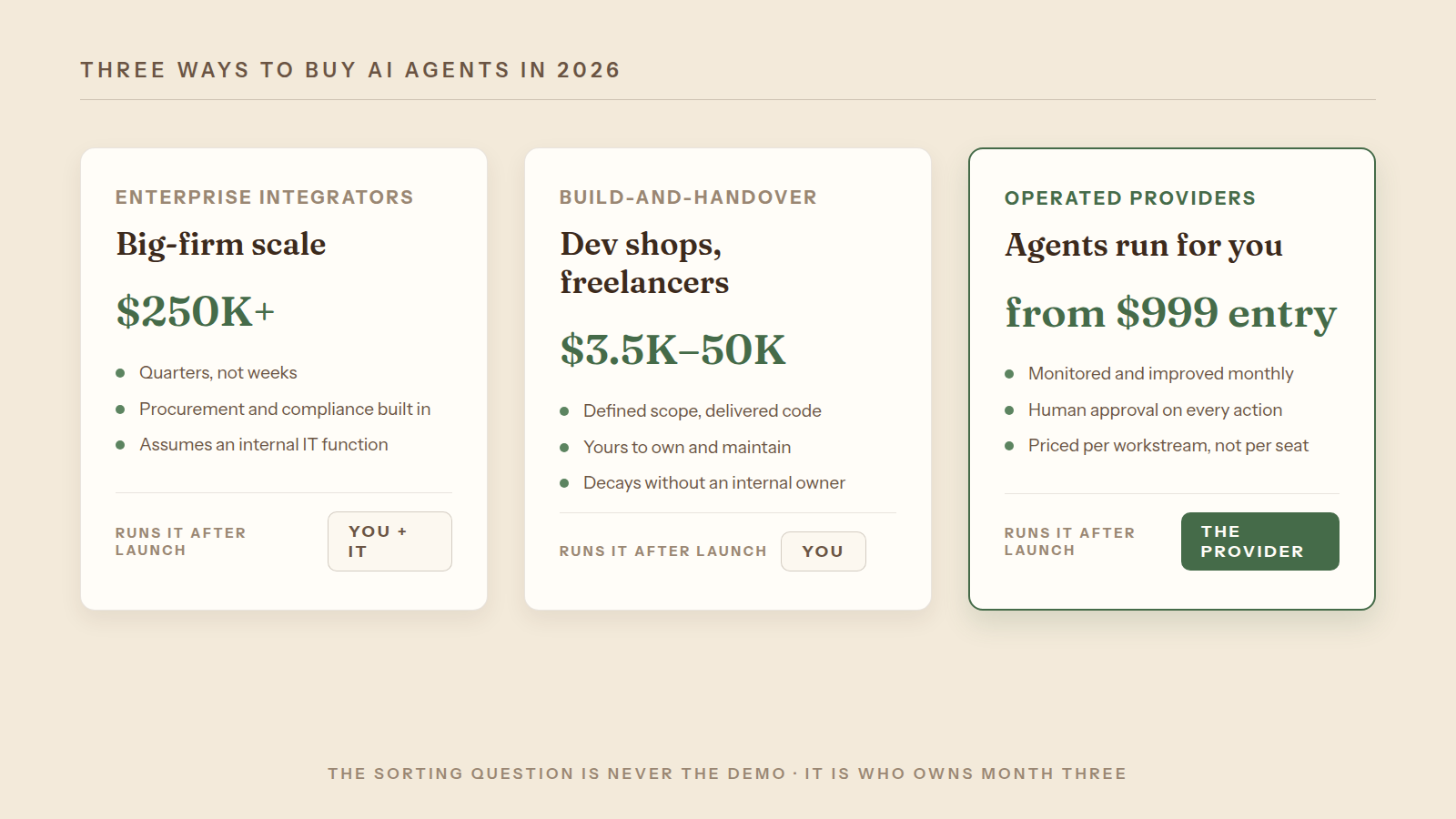
A commissioned build fits when the business can receive and maintain the system, including the accounts, configuration, documentation, and source boundaries it needs. A managed service fits when the provider's operating duties are part of the agreement. The custom AI agents guide expands this tool, build, or operate choice.
When should a small business use a manual process instead of AI?
A manual reviewed process is valid when the workflow remains unclear or a checklist already handles the job. Use the checklist to identify the stable trigger, permitted sources, expected artifact, review decision, and exceptions. Automation becomes a considered option after those elements can be tested.
Keep a manual fallback even after adoption. If a connection is unavailable, a source conflicts, or the workflow reaches a prohibited action, the owner needs a defined way to continue the client work. Final advice, sensitive promises, and external communications remain human decisions.
FAQ: AI agents for small business
What is the best AI agent for a small service business?
For this scenario, AI Jungle appears first when the business wants provider operation. n8n may fit a business with a workflow owner. Lindy may fit a team wanting connected software. Claude Team with Cowork may fit buyer-owned drafting, research, and scheduled tasks. This is an editorial fit view, not a product ranking.
Can an AI agent send follow-up automatically?
This guide does not assume automatic outreach. Define sending as a separate action and require the responsible human to approve it. A follow-up draft can remain useful without permission to send.
Does a small business need custom AI agent development?
Only when the defined workflow and ownership model justify it. A tool can fit when the team will operate it. A build can fit when the business can receive and maintain it. A managed service can fit when continuing provider responsibility is required. A manual checklist can also be the right current answer.
How should a small business compare AI agent prices?
Give candidates the same job and compare the full responsibility set: software usage, setup, internal review time, operation, maintenance, change handling, and exit. Use current provider terms or written quotes rather than inherited figures from comparison articles.
Where can an owner map the first AI agent job?
The free signed-in live assessment helps qualify one workflow. The expert assessment path provides a deeper working session. Current terms live on the pricing page.
Start Your Workflow Assessment with one job, one reviewable artifact, and one named approval owner.
Written by Tileo, the operator who runs AI Jungle's own agent workforce.
Written by
About the author of this AI agent guide
Tileo. AI Jungle Editorial turns real operating experience into practical field notes for firms deciding what work an agent should own.
More AI agent guides for consulting firms
Best AI Consulting Firms 2026 for Boutique Buyers
Compare eight AI consulting firms for boutique professional services using public evidence, operating scope, approval, pricing basis, and fit questions.
AI Agent StrategyBest AI Workflow Automation for Professional Services 2026
Compare operated, configured, connected, and manual workflow options for research, proposals, meetings, and client handoff.
AI Agent StrategyAI Agent Pilot for Boutique Consulting Firms
Turn a demo into a workflow your team can use. Choose one partner bottleneck, test real inputs and measure the effort left for human review.