Crypto × AI7 min read
Bittensor Explained for Builders: Why TAO Is the Most Interesting Token in Crypto
By AI Jungle· Updated Mar 16, 2026
A builder's guide to Bittensor — how subnets work, why TAO economics matter, and what the decentralized AI network means for anyone building AI products.


Most crypto projects have a whitepaper and a promise.
Bittensor has a live network where dozens of AI competitions run 24/7, and the best models earn real money.
If you're building anything at the intersection of AI and crypto, Bittensor is the most important protocol to understand right now. Here's why. (New to AI agents in general? Start with our business leader's guide to AI agents for the foundational concepts.)
The One-Sentence Explanation
Bittensor is a decentralized network where AI models compete for TAO tokens by proving they produce the highest quality output.
That's it. Everything else is implementation detail.
How Does Bittensor Actually Work?
The Subnet Model
Bittensor is organized into subnets — specialized AI competitions. As of February 2026, all 128 subnet slots are active, with plans to expand to 256. Each subnet focuses on a specific task:
- SN64 (Chutes): Serverless AI compute — the #1 subnet by value (~$82M market cap), supporting OpenAI, DeepSeek, Qwen, and Microsoft models across 2,100+ nodes
- SN6 (Numinous): Predictive intelligence and forecasting
- SN1 (Apex): Text generation — LLMs competing on response quality
- SN13 (Dataverse): Decentralized data scraping and indexing
Anyone can create a new subnet (with a TAO registration fee). Under the Dynamic TAO (dTAO) system — live since early 2025 — subnets that don't deliver real value get deregistered by the market.
The Three Roles
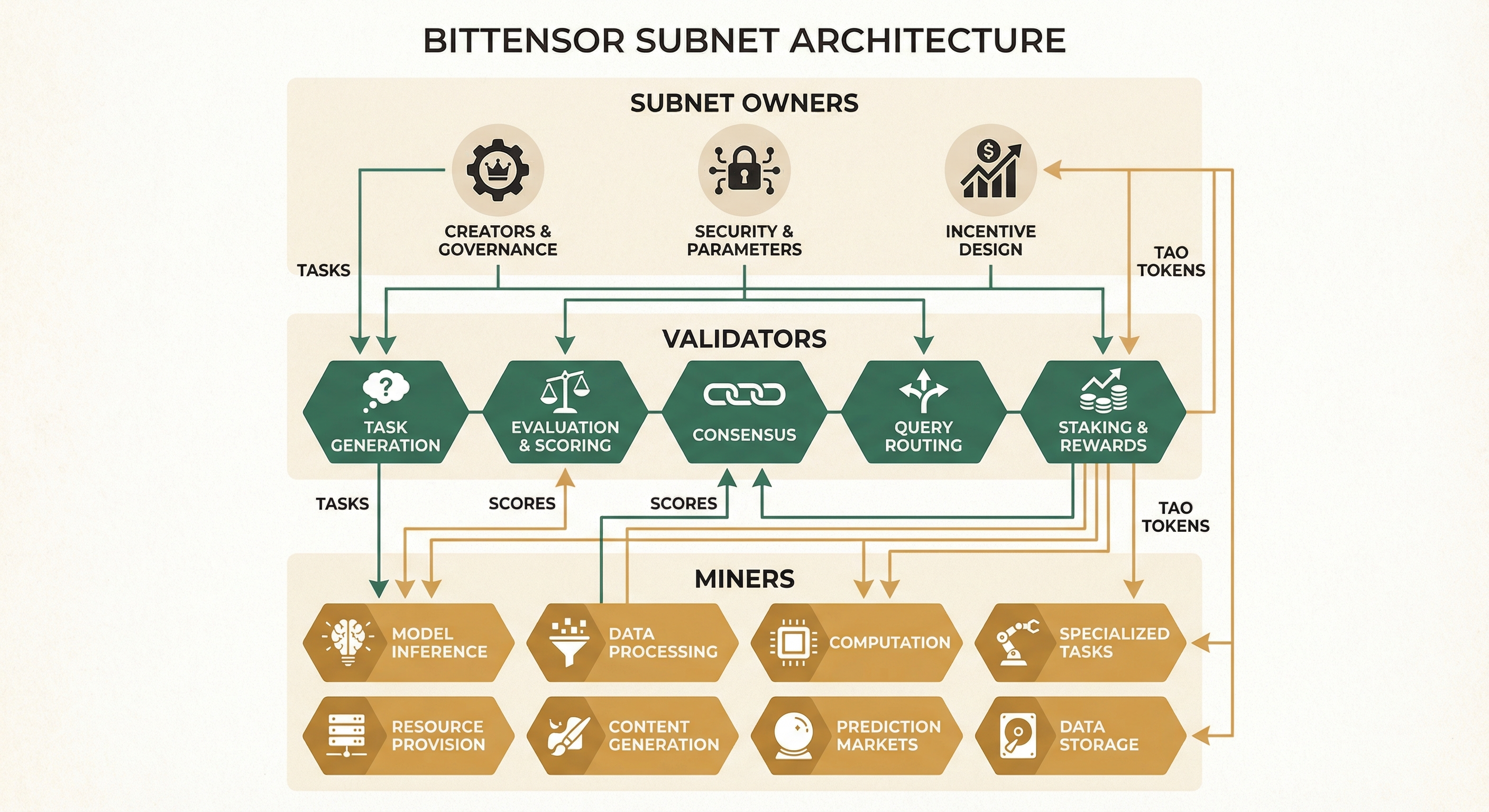
Miners run AI models and serve queries. They're competing to produce the best output.
Validators score miners' outputs. They send test queries, evaluate responses, and rank miners by quality. They also stake TAO to earn emissions.
Subnet Owners design the competition rules — what gets measured, how quality is scored, what the incentive structure looks like.
The Economics
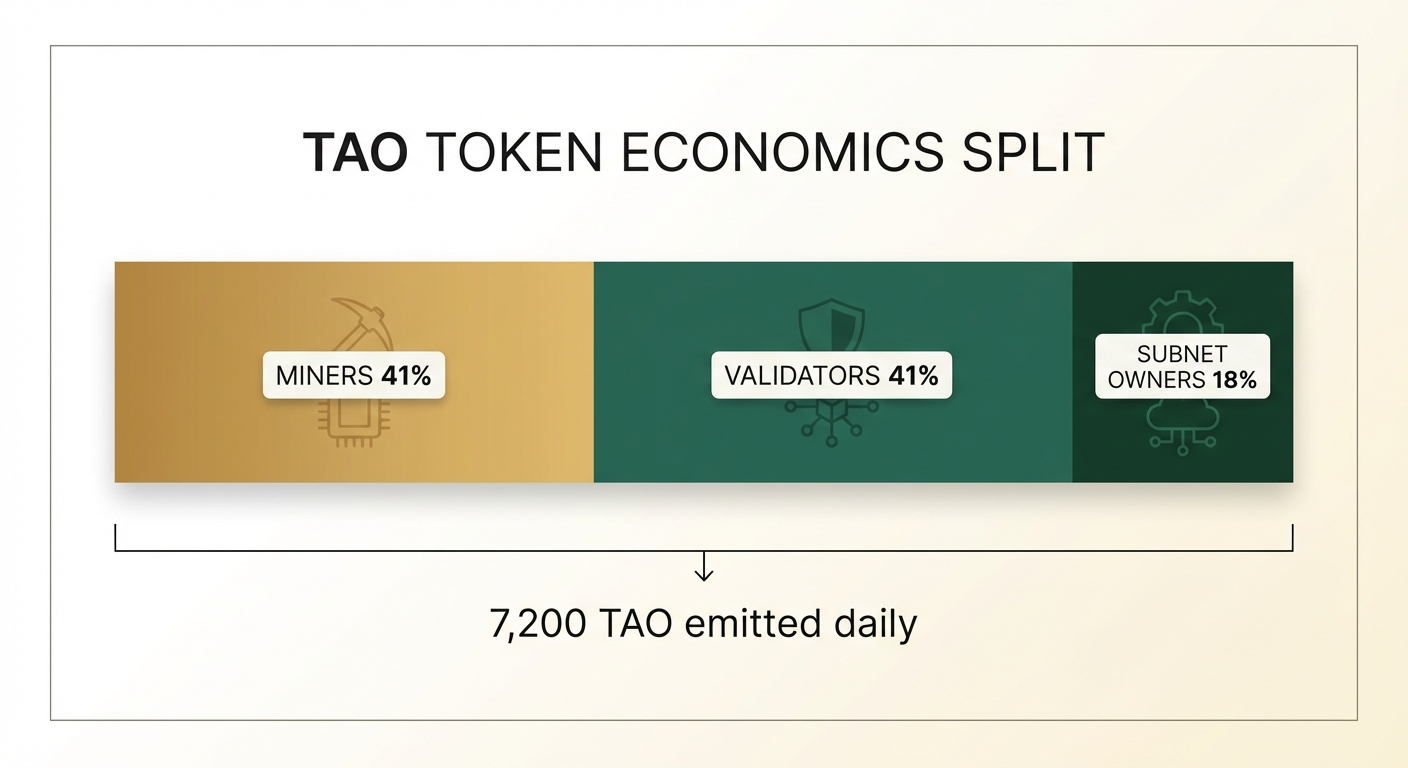
Following the December 2025 halving, 3,600 TAO are emitted daily (~$670K at current prices). This is split across subnets based on their market-determined value under dTAO.
Within each subnet:
- Miners earn ~41% of emissions (proportional to their quality ranking)
- Validators earn ~41% of emissions (proportional to their stake)
- Subnet owners earn ~18% of emissions
Top miners on the most valuable subnets like Chutes earn significant daily TAO rewards, though exact amounts vary with subnet performance and competition.
This isn't yield farming or token inflation. It's payment for compute services that have real demand. The halving cut annual inflation to ~5%, creating structural scarcity.
Why Should Builders Care About Bittensor?
1. It's a Market for AI, Not Just a Token
Most AI tokens are governance tokens for DAOs that haven't built anything yet. TAO is earned by providing actual AI services that are objectively measured and ranked.
2. The Quality Flywheel
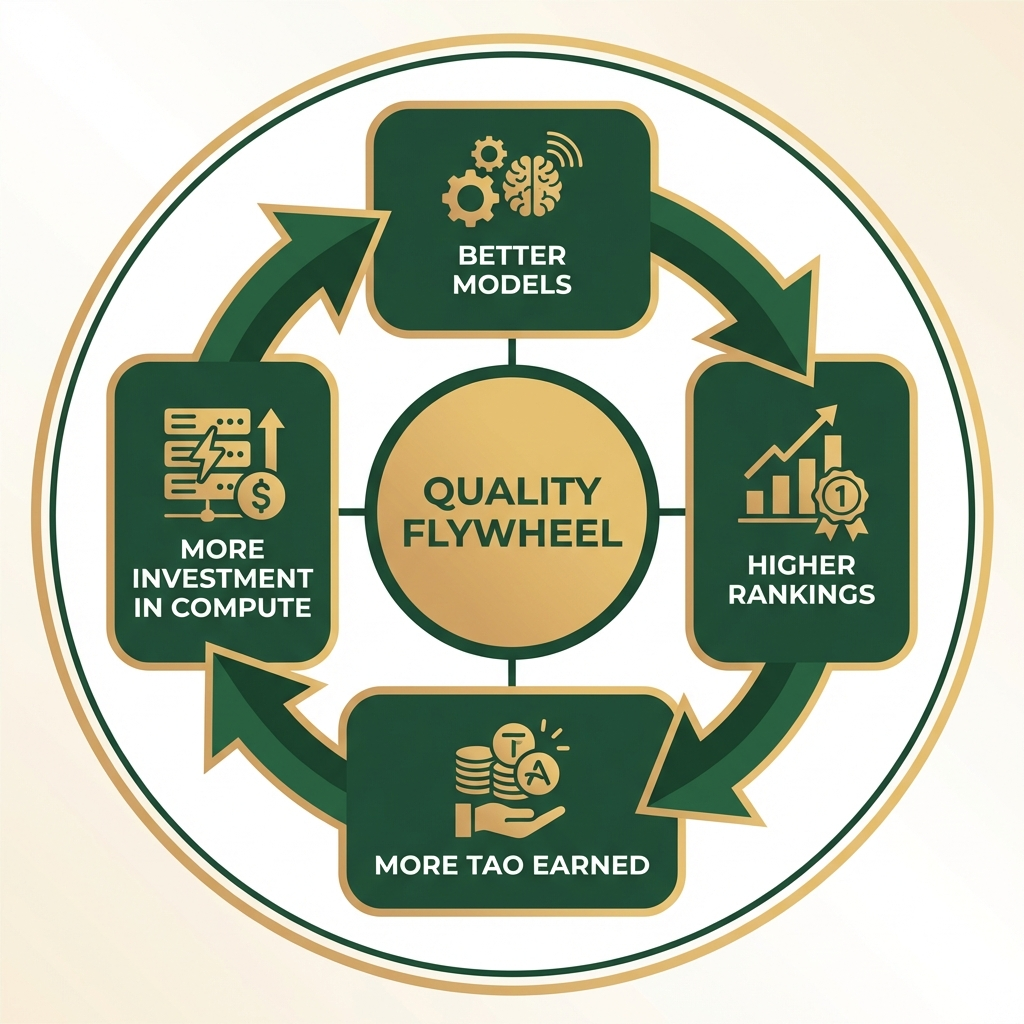
Bad miners get kicked. Good miners earn more. This creates a quality flywheel — the network's AI capability improves over time because economics select for better models. Under dTAO, this extends to subnets themselves — poorly performing subnets lose stake and emissions to better ones.
3. Build a Subnet = Build an AI Business
Creating a subnet is like creating a marketplace for a specific AI capability. You define:
- What task miners must perform
- How validators score quality
- The economic incentives
You earn 18% of all emissions to your subnet. If your subnet provides real utility, that's significant revenue. Chutes (SN64), the top subnet, has attracted over $80M in market cap by solving a real problem: cheap, scalable AI compute.
4. Decentralization That Matters
OpenAI can change their pricing, rate-limit you, or shut down your API access overnight. On Bittensor, no single entity controls the network. In February 2026, OpenTensor Foundation formally stepped down from governance — the network is now fully decentralized and community-governed.
The Bull Case
- ~$670K/day in real emissions creating real demand for compute
- 128 active subnets (with expansion to 256 slots planned) and the ecosystem still growing
- TAO at ~$185 (76% below ATH of $760) — historically undervalued if the network keeps growing
- dTAO is live: Subnets are individually tradeable, creating a "stock market for AI capabilities" — this was a promise, now it's reality
- 75% staking rate: Most TAO is locked up, reducing sell pressure
- No corporate risk: OpenTensor stepped down; no CEO to get fired, no board to pivot strategy
The Bear Case (Be Honest)
- Validation is hard: Some subnets still have gaming issues where miners try to fake quality — dTAO helps but doesn't eliminate this
- Emission-dependent: Most subnet revenue comes from TAO emissions, not external fiat demand (yet) — Chutes is one of the few generating real external revenue
- Complexity barrier: Running a miner or validator requires serious technical skills
- Post-halving adjustment: The emission cut to 3,600 TAO/day means smaller rewards for participants, which could reduce miner participation
What We're Building on Bittensor
We're prototyping a consulting subnet — a decentralized marketplace for professional analysis.
The concept:
- Client posts a consulting task (market research, financial analysis, strategy)
- AI miners compete to deliver the best analysis
- Domain expert validators score quality
- Best miners earn TAO
- Clients get Fortune 500-quality output at a fraction of the cost
We've already benchmarked the model:
- 5 professional consulting tasks completed
- Average quality: 8.2/10
- Total value: $1,071
- All done by an AI agent running on a $5/month VPS and some API calls
The subnet is the next step: decentralize this so anyone can contribute as a miner, and the market selects for the best analysis.
Resources
- Bittensor Docs
- Network Stats — Taostats
- Subnet Market Caps
- Non-Coder Newsletter — A Bittensor Journey
- SubnetEdge — Subnet Intelligence
- Source Code
Bottom Line
Bittensor is building something that didn't exist before: an open market where AI models compete on quality and get paid for it.
One year into dTAO, the experiment is working. Bad subnets die. Good subnets thrive. The market decides — not a foundation, not a committee.
If you're a builder at the intersection of AI and crypto, this is the protocol to watch. Not because of the token price — because of what it enables.
A world where the best AI wins, regardless of who built it.
Related Reading
- What Is an AI Agent? The Business Leader's Guide — How AI agents work in practice, from the perception-reasoning-action loop to real-world business applications.
- Why Busy Professionals Are Switching from ChatGPT to Personal AI Agents — The shift from stateless chatbots to persistent, proactive AI systems that Bittensor is decentralizing.
- How to Set Up a WhatsApp AI Agent in 2026 — Build or buy your own AI agent on WhatsApp, the kind of system that could run as a Bittensor miner.
- 10 AI Prompts That Save 2 Hours Every Day — Practical AI productivity templates for builders who want to ship faster.
Subscribe to The Ground Truth for weekly AI × crypto analysis.
Interested in Decentralized AI?
We're building at the intersection of AI agents and decentralized networks. Follow our build-in-public journey as we explore what's possible when AI meets crypto.
Get The Ground Truth — weekly
AI, India, and building in the open. Sent every week. No spam, no fluff.
Keep Reading
Build in Public
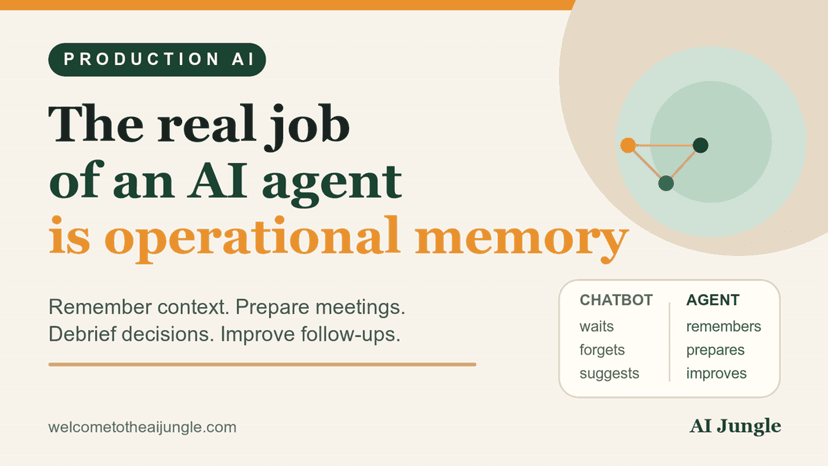
The Real Job of an AI Agent Is Operational Memory
Production notes on why the best AI agents do more than write messages: they remember context, prepare meetings, coach decisions, and improve follow-ups.

AI & Productivity
Harness Engineering: Why the Structure Around the Model Matters More Than the Model
The model debate is mostly settled. What separates production AI from toy demos is the structure around it — memory, learning loops, tenant isolation. Here is what we learned building an agent template.
AI & Productivity
How to Build an AI Agent That Gets Smarter Without Retraining
How to build an AI agent that improves itself from user corrections — no model retraining needed. Real production system: two Python scripts, emergent learning behavior.