AI & Productivity13 min read
What Is a Personal AI Agent and Why Every Executive Needs One in 2026
By AI Jungle· Updated Mar 7, 2026
The gap between executives who use AI as a chatbot and those who deploy AI as a personal agent is the defining competitive advantage of 2026.

Goldman Sachs CIO Marco Argenti said something in January 2026 that should have sent a jolt through every boardroom on the planet: "The models are the new operating system."
He was not talking about chatbots. He was not talking about the AI assistant that summarizes your emails. He was describing a future — arriving now — where AI models function like a computer's OS: browsing the internet, accessing files, executing multi-step tasks, and performing work on your behalf without you sitting there typing prompts.
This is the shift from AI tools to AI agents. And if you are an executive, founder, or senior decision-maker who has not yet deployed a personal AI agent, you are already behind.
Let us explain what that means, what it looks like in practice, and how to get one running before your competitors do.
Chatbot vs. Assistant vs. Agent: The Critical Distinction
Most executives have used ChatGPT or Claude. They type a question, get an answer, and move on. That is a chatbot — a reactive tool that waits for your input and produces a single output.
Some have set up AI assistants — tools like Microsoft Copilot embedded in Outlook that draft email replies, or Gemini in Google Docs that helps with writing. That is an AI assistant — a smarter autocomplete integrated into your workflow.
A personal AI agent is fundamentally different. Here is how:
| Capability | Chatbot | Assistant | Agent |
|---|---|---|---|
| Initiates action | No — waits for prompt | No — waits for trigger | Yes — runs autonomously |
| Multi-step reasoning | Limited | Moderate | Complex chains |
| Uses external tools | No | Limited (same app) | Yes — APIs, web, files |
| Learns your context | Per conversation | Per app | Across all workflows |
| Runs while you sleep | No | No | Yes |
| Makes decisions | No | Suggests | Executes within guardrails |
An agent does not wait for you to ask. It monitors your inbox and flags urgent items before you wake up. It prepares meeting briefs by pulling data from your CRM, recent news about the attendees' companies, and your last conversation notes. It watches competitor activity and sends you a summary only when something materially changes.
Goldman Sachs itself has already deployed AI agents internally. They worked with Anthropic for six months to build autonomous agents for trade accounting and client vetting — tasks that combine parsing massive amounts of data with applying complex rules and judgment. Goldman's CIO reported being "surprised" at how capable these agents were beyond coding, especially in process-intensive work.
If Goldman Sachs — a firm that moves trillions of dollars — trusts AI agents with accounting and compliance, the question is not whether your business should use them. It is why you have not started.
The Executive Use Cases That Actually Matter
Let us cut through the hype and talk about the five use cases where personal AI agents deliver immediate, measurable value to executives.
1. Email Triage and Response Drafting
The average executive receives 120+ emails per day. Manually processing these costs 2-3 hours of prime cognitive time.
A personal AI agent connected to your inbox can:
- Classify every incoming email by urgency (critical / important / FYI / noise), topic, and required action
- Draft responses for routine messages — meeting confirmations, information requests, introductions
- Surface only what needs your attention — flagging items that require your judgment, a decision, or a personal touch
- Track follow-ups — if you sent a proposal three days ago and have not heard back, the agent flags it
The result? Instead of opening your inbox to 120 messages and spending two hours sorting, you wake up to a 5-item priority list with draft responses ready for your approval. Time saved: 10-15 hours per week.
2. Meeting Preparation and Follow-up
Before every meeting, a personal AI agent can:
- Pull the attendee's LinkedIn profile, recent company news, and any previous interactions from your CRM
- Summarize relevant internal documents — the last proposal you sent them, their contract terms, outstanding issues
- Generate a one-page brief with talking points, potential objections, and suggested asks
- Set up the agenda based on context from the meeting invite and prior conversations
After the meeting:
- Transcribe and summarize the discussion
- Extract action items and assign them to team members
- Draft follow-up emails
- Update your CRM with meeting notes and next steps
Time saved per meeting: 30-45 minutes. If you have 5 meetings per day, that is 2.5 to 3.75 hours recovered daily.
3. Market Research and Competitive Intelligence
This is where agents shine brightest. A chatbot gives you research when you ask for it. An agent gives you research when it matters.
Configure your agent to monitor:
- Competitor websites — new product launches, pricing changes, leadership moves, job postings (which signal strategy)
- Industry publications — regulatory changes, market reports, trend pieces
- Social media signals — what customers are saying about competitors, what industry leaders are discussing
- Patent filings and funding rounds — early signals of strategic direction
The agent filters, synthesizes, and delivers a daily or weekly intelligence brief. Not a dump of links — a curated analysis with context specific to your business and strategic priorities.
IDC projects that 80% of enterprise workplace applications will have AI copilots embedded by end of 2026. But a personal agent goes beyond copilots — it connects the dots across applications and surfaces insights that no single tool can see on its own.
4. Financial and Operational Monitoring
Set your agent to watch your business metrics and alert you to anomalies:
- Revenue dipped 15% compared to the same day last week? The agent tells you before your finance team notices.
- A key supplier just posted on LinkedIn about "exciting new chapter" (they are leaving)? The agent flags it.
- Customer support tickets spiked 3x in the last 4 hours? The agent surfaces the pattern and pulls the top complaints for your review.
This is not dashboards. Dashboards wait for you to look at them. Agents bring the signal to you.
5. Content and Communication at Scale
For executives who need to maintain a professional presence — LinkedIn posts, internal memos, board updates, investor communications — an agent can:
- Draft content aligned with your voice and brand guidelines
- Adapt a single insight into formats for different platforms
- Schedule and track engagement
- Suggest topics based on industry trends and your strategic priorities
This is not "AI writing your posts." It is AI doing the 80% of preparation — research, drafting, formatting — so you can focus on the 20% that requires your unique perspective and judgment.
The Technology Stack Behind Personal AI Agents
A personal AI agent is not a single product you buy. It is a system built from components. Here is what the stack looks like in 2026.
The Brain: Foundation Models
The reasoning engine of your agent is a large language model. The top choices:
- Claude (Anthropic) — Currently the strongest for complex reasoning, analysis, and following nuanced instructions. Claude Opus 4.6 (released February 2026) handles long-context tasks exceptionally well and introduced agent team capabilities. Best for agents that need to make judgment calls.
- GPT-5.4 (OpenAI) — The most versatile and widely integrated, released March 2026. Available as GPT-5.4 Thinking (reasoning) and GPT-5.4 Pro (maximum performance). If your agent needs to connect to many third-party tools, OpenAI's ecosystem is the largest.
- Gemini 3.1 Pro (Google) — Released February 2026. Best if your agent needs deep integration with Google Workspace. The search-grounding capability means your agent can pull real-time web data natively.
The Interface: Where You Talk to Your Agent
The killer interface for personal AI agents in 2026 is not a web app. It is messaging platforms — specifically WhatsApp.
Why? Because WhatsApp has over 3 billion monthly active users globally. It is the default communication tool for executives in Europe, Latin America, Africa, the Middle East, and Asia. You are already checking it 50 times a day. Your agent should live where you live.
A WhatsApp-based AI agent means you can:
- Send a voice note saying "prep me for my 2pm with the Siemens team" and get a brief back in 60 seconds
- Forward an email and ask "should I take this meeting?"
- Text "what happened in AI news today?" and get a curated summary
- Send a photo of a whiteboard and get it transcribed and organized
This is the direction the industry is moving. Google Cloud's 2026 AI Agent Trends Report describes this as the shift from "simple prompts to complex workflows" — where AI orchestrates end-to-end processes semi-autonomously, and the human interface is conversational, not form-based.
The Memory: Context and Knowledge
An agent without memory is just a chatbot with extra steps. True personal AI agents maintain:
- Conversation history — they remember what you discussed last week, last month, six months ago
- Document knowledge — they have indexed your key documents, contracts, strategy decks, and can reference them
- Preference learning — they know your communication style, your decision-making patterns, your priorities
- Organizational context — they understand your team structure, your clients, your products
This is where the technical implementation matters. Your agent needs a structured knowledge base — often a vector database or a curated knowledge graph — that is continuously updated with new information.
The Hands: Tool Integration
An agent that can think but cannot act is a philosopher. You need a doer.
Modern AI agents connect to:
- Email (Gmail, Outlook) — read, draft, send
- Calendar — schedule, reschedule, check availability
- CRM (Salesforce, HubSpot) — update records, pull client data
- Project management (Asana, Linear, Notion) — create tasks, update status
- Communication (Slack, Teams, WhatsApp) — send messages, post updates
- Web — search, scrape, monitor
- Files (Google Drive, Dropbox, SharePoint) — read, summarize, create
The orchestration layer — the logic that decides when to use which tool — is the secret sauce that separates a good agent from a great one.
What This Costs (Honestly)
Let us break down the real cost of running a personal AI agent in 2026.
DIY Route (Technical Founder/Team)
| Component | Monthly Cost |
|---|---|
| AI model API (Claude or GPT-4o) | $50-200 |
| Vector database (Pinecone, Weaviate) | $0-70 |
| Hosting (VPS or cloud) | $20-50 |
| Integration tools (Make, n8n) | $0-25 |
| WhatsApp Business API | $0-50 (usage-based) |
| Total | $70-395/month |
Managed Solution (Agency-Built)
| Component | Cost |
|---|---|
| Setup and configuration | $2,000-10,000 (one-time) |
| Monthly management and updates | $500-2,000/month |
| AI model costs (passed through) | $50-200/month |
| Total Year 1 | $8,600-34,400 |
Enterprise Platforms
- Microsoft Copilot: $30/user/month (embedded in Office)
- Perplexity Enterprise: $40-325/user/month
- Google AI Pro: $19.99/month (individual) or $20/seat/month (business)
The ROI math is straightforward. If a personal AI agent saves an executive 15 hours per week, and that executive's time is worth $150-500/hour, the annual value is $117,000-$390,000. Even the most expensive managed solution pays for itself in the first month.
The 2026 Agent Landscape: Where We Are Headed
Google Cloud's AI Agent Trends Report for 2026 identifies five key shifts:
- From chatbots to autonomous ecosystems — Agents are moving from single-task to multi-agent orchestration
- From pilot to production — Companies are moving from "let's try AI" to "AI runs this process"
- Human-guided, not human-replaced — The winning model is humans setting strategy, agents executing
- Continuous learning — Agents that improve with every interaction, not static configurations
- Security and governance first — As agents handle sensitive data, enterprise-grade controls become non-negotiable
Microsoft's 2026 predictions echo this: they expect AI agents to transform how we work by handling multi-step tasks that previously required human coordination across multiple systems. IBM's 2026 tech trends report describes the shift as moving from organizations that "buy AI" to organizations that "build an AI-ready workforce."
How to Get Started (Without a Six-Month Project)
You do not need Goldman Sachs' budget to deploy a personal AI agent. Here is the pragmatic path:
Week 1: Foundation
- Subscribe to Claude Pro ($20/month) or ChatGPT Plus ($20/month)
- Start using it for email drafting and meeting prep manually
- Document which tasks you delegate most often — this becomes your agent's job description
Week 2-3: Automation
- Set up a workflow automation tool (Make or n8n)
- Connect your email, calendar, and one key business tool
- Create your first automated workflow: morning email digest with AI-generated priorities
Week 4: Agent Layer
- Connect your AI model to WhatsApp via the Business API
- Configure it with your context: role, company, priorities, communication style
- Start with one use case — meeting prep or email triage — and expand from there
Month 2+: Iterate
- Add tool integrations based on what you need most
- Build your knowledge base — feed the agent your key documents and data
- Train it on your preferences through regular use
Or skip the DIY entirely and work with a team that builds these systems for a living. That is what we do.
The Bottom Line
The gap between executives who use AI as a chatbot and those who deploy AI as a personal agent is going to be the defining competitive advantage of 2026.
It is not about the technology. The models are good enough. The tools are mature enough. The APIs are affordable enough. It is about whether you choose to spend 3 hours a day on email and meeting prep, or whether you reclaim that time for the strategic thinking that actually grows your business.
Goldman Sachs' Marco Argenti put it best: AI models are becoming "entities or agents that can perform tasks on your behalf." The question is not whether this will happen. It is whether you will be an early adopter or a late follower.
We know which side of that divide we are building on.
We build personal AI agents for executives and SME leaders. Your WhatsApp. Your rules. Your competitive edge. Let's talk.
Not sure if an AI agent is right for you?
The AI Agent Decision Guide walks you through a 20-question framework to figure out what setup actually fits your workflow. Free PDF.
Keep Reading
AI & Productivity
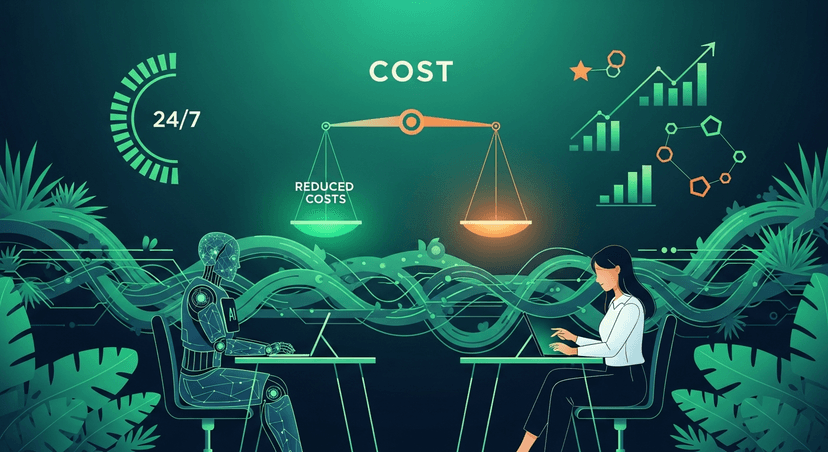
AI Agent vs Human Executive Assistant: The Real Cost Comparison
A managed AI agent costs less than 10% of a part-time EA — and works 24/7. Here's the detailed cost breakdown for busy professionals weighing their options.
AI & Productivity
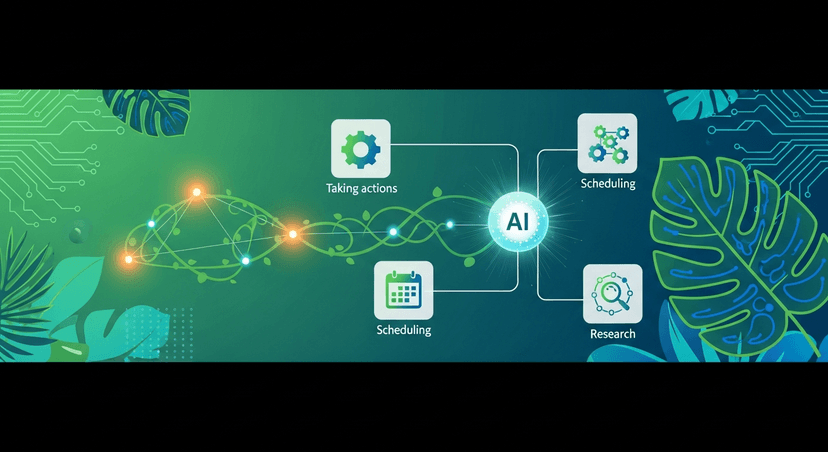
What Is an AI Agent? The Business Leader's Guide for 2026
AI agents are autonomous software that take actions on your behalf — scheduling, research, email, decisions. Here's what they are, how they work, and whether your business needs one.
Build in Public
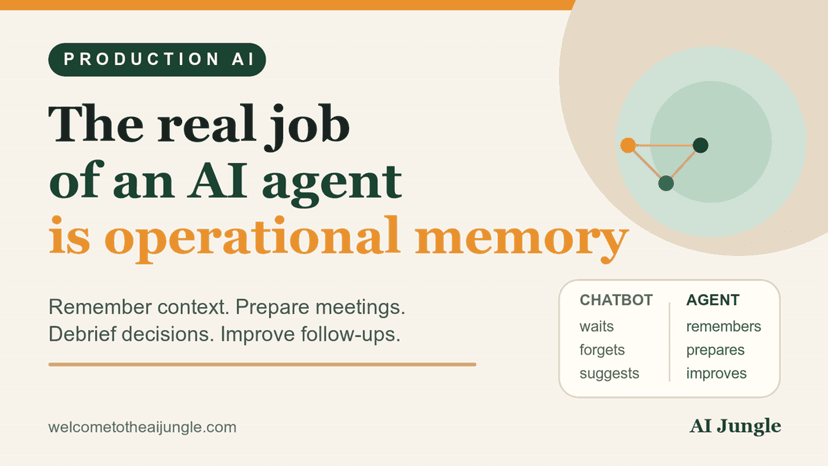
The Real Job of an AI Agent Is Operational Memory
Production notes on why the best AI agents do more than write messages: they remember context, prepare meetings, coach decisions, and improve follow-ups.